How to Publish 100+ KDP Books a Year (Cover Production at Scale)
High-volume KDP publishing — journals, planners, puzzles, coloring — lives on cover PRODUCTION speed, not on writing. The winners use a template system: one strong layout, then clone it and swap theme, color and title per book, batched by niche. The trap is looking generic; vary the theme, not the quality, and keep a recognizable series identity. A fast, size-accurate cover tool is what breaks the bottleneck.
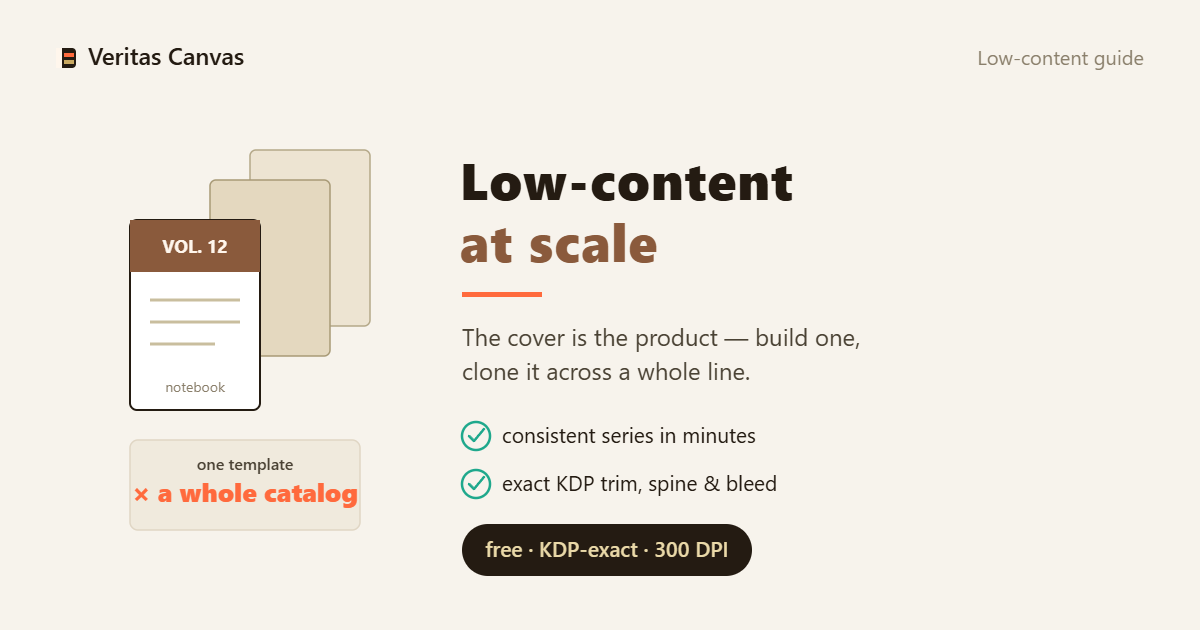
Low-content = production, not writing
Here's the opportunity: no manuscript. Journals, planners, puzzles and coloring books need no text — what they sell is an interior template plus a cover. So the real bottleneck is covers, at KDP-correct sizes. The equation is simple: speed × quality = volume. With no writing load, the only variable that scales is the speed and consistency of your cover production line.
The template system: clone and swap
You don't design 100 covers from scratch. Build one strong layout per niche — typography hierarchy, grid and color slots defined — then clone it and swap theme, color and title per book. A system is far faster than reinventing each cover and gives you consistency for free. The designer's job is to build the layout once; production is just cloning it.
Batch by niche, not one-by-one
Throughput lives in batching, not one-offs. Research a niche ('gratitude journals', 'sudoku', 'mandala coloring'), then produce that whole series in one sitting with a consistent identity. Ten variants inside one system beat ten separate projects. The research → batch → upload loop is the real engine of output.
Avoid the generic-template trap
The number-one reason volume publishers fail: the covers all look the same or stock. Scale only works if there's an identity. Build a recognizable series identity and add real theme variation — a distinct series outsells a generic one even at lower volume. The goal isn't many covers, it's many selling covers; those aren't the same thing.
Speed without breaking KDP specs
Volume is worthless if the covers get rejected. Use a tool that locks the correct trim, bleed, spine width and 300 DPI so every clone comes out print-ready. Rework is the hidden enemy of scale: a single wrong-size mistake propagates across hundreds of covers. Automating size-accuracy is the real multiplier.
Recommended resources
- Amazon — self-publishing guide books
Some links below are affiliate links — at no extra cost to you.